
Freshman Year Foundations
Starting high school brings new opportunities, a faster pace, and a different set of expectations. Your student may be excited to explore new interests while still figuring out how to manage classes, homework, and activities. Many families wonder whether freshman year is too early to begin thinking about college. However, it's not too early to start building strong habits that will support your student throughout high school and the college application process.


Note from our Founder
One of my favorite sayings is to “Begin with the end in mind,” but that doesn't mean you need to have your future figured out as a freshman. You are not behind: explore your interests, build good habits, and ask for help when you need it. Pay attention to what gives you joy, because getting to know yourself is an important first step in your journey to college.
— Keith Wilkerson, CEO and Founder
This Year's Priorities
Encourage your student to begin with these three priorities and practical steps.
Build Effective Study Routines
The transition from eighth to ninth grade can be a big one. A consistent routine can help students organize their responsibilities and recognize when they need to adjust their approach.
- Keep assignments, tests, and activity commitments in one planner or calendar. Choose a regular time each day to check deadlines and update it.
- Plan study time throughout the week. Break larger assignments into smaller sections, and schedule time to review material before an upcoming test.
- Review your graded work and identify mistakes to revisit. Use study time for specific tasks, such as practicing math problems, reviewing vocabulary, or outlining an essay.
- At the end of each week, ask: Which tasks took longer than expected? What helped me prepare? What should I change next week?
Learn to Ask for Help
Knowing when and how to ask for help is an important part of becoming an independent learner.
- Find out how each teacher prefers to be contacted and when extra help is available.
- Identify a specific question or point of confusion. Bring an assignment, test, or example that shows where the difficulty begins.
- Explain what you have already tried. For example: "I reviewed my notes, but I am still unsure how to start this problem."
- Ask what to practice next, try the suggested approach, and follow up if questions remain.
Explore Interests and Find Balance
Freshman year offers opportunities to try clubs, sports, creative pursuits, and other activities without needing to identify a lifelong passion immediately.
- Choose an activity that interests you and learn what joining involves, including meeting times, costs, transportation, and participation expectations.
- Consider how each commitment fits alongside schoolwork, responsibilities at home, and time for rest before committing.
- After a few weeks, reflect: What do I enjoy? What am I learning? Do I want to continue exploring this interest?
- If your schedule feels too full, identify which commitments matter most and discuss possible adjustments with a parent, teacher, or activity leader.
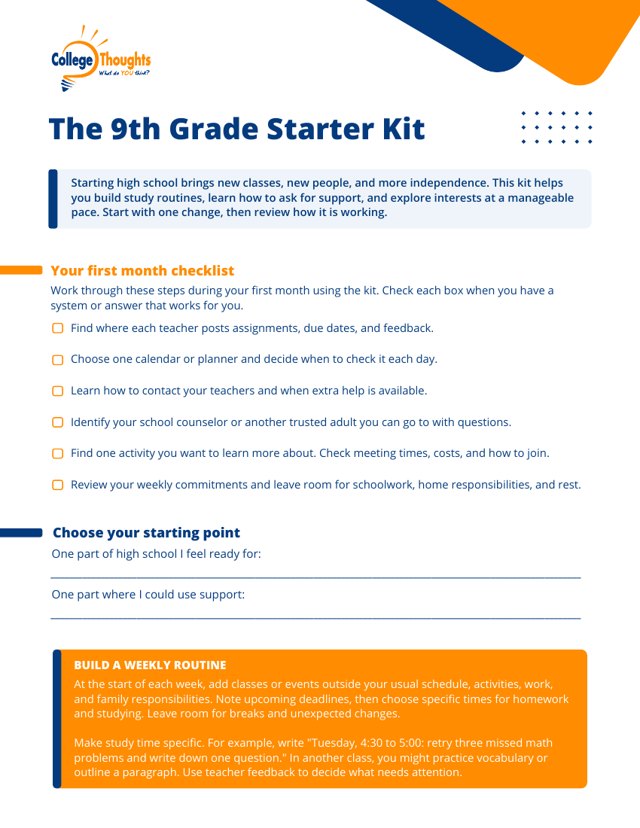
Free Resource
Ready to Put These Priorities Into Action?
We've put together a comprehensive resource for freshmen to identify strengths, weaknesses, and interests. Take some time to work through this as a family and make a plan for success. Fill out the form below to get your copy!
The 9th Grade Starter Kit
How We Help 9th Graders
The CollegeThoughts Approach
Ready to start high school off right? Contact us!
At CollegeThoughts, we help ninth graders develop study routines, balance schoolwork and activities, and learn when and how to ask for support.
Our advisors help students organize their responsibilities, choose effective study strategies for different classes, and adjust their approach when something isn't working. For example, a student who was usually confident in math came to us frustrated with geometry. Together, we identified two changes: reviewing mistakes soon after receiving graded work and asking their teacher for help after school. The student finished the class with a grade they were proud of. Our goal is to help students build confidence, recognize the support they need, and develop practical skills so they can start high school on a strong note.
Questions From Families
Frequently Asked Questions
Yes! Freshman-year grades typically count toward a student's cumulative high school GPA and appear on their academic transcript. Colleges may consider the full high school record, including course rigor and grade trends. Freshman year is also a chance to build strong study habits and learn to manage higher academic expectations. One challenging semester does not define a student's future, but building a solid foundation now can help.
There is no magic number. Encourage your student to explore a few activities that genuinely interest them, whether through school clubs, sports, music, theater, volunteering, work, or independent projects. Depth, consistency, growth, and meaningful participation often matter more than joining as many clubs as possible.
Establish a predictable routine for homework, studying, sleep, and checking assignments. Ask open-ended questions about how school is going, help your student develop a system for tracking deadlines, and encourage them to communicate directly with teachers when they need help. Gradually transfer responsibility to your student while remaining available for support.
Explore Other Years